
Access generative media models through one API and deploy models on serverless GPUs.
Verified Nov 2, 2026
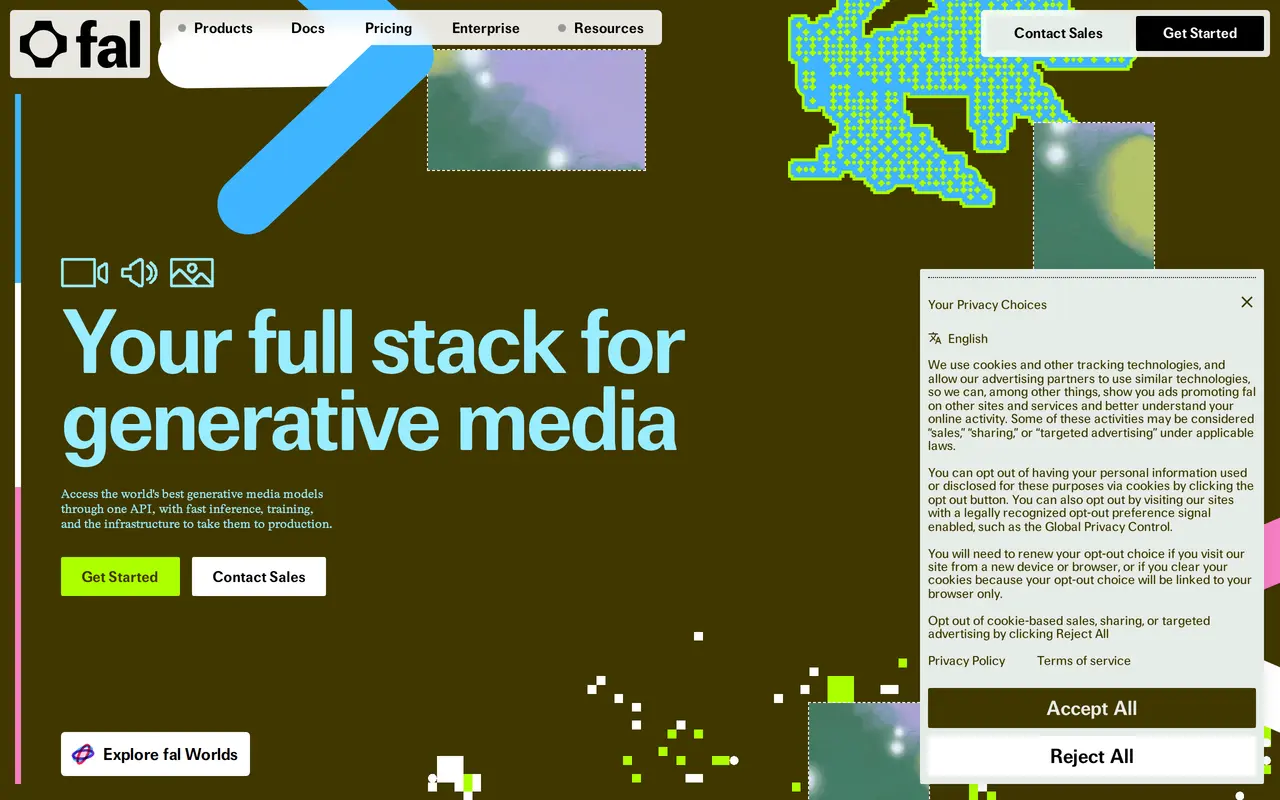
What is fal?
fal is a developer platform for building applications that generate and edit images, video, audio, and 3D content. It provides access to more than 1,500 generative media models through a unified API, allowing developers to integrate models from different providers without managing separate integrations. Its catalog includes text-to-image, image-to-video, speech synthesis, image editing, and 3D generation capabilities.
Developers can call hosted models through the API and SDKs, use their own LoRAs, or deploy private and fine-tuned models with their own weights. Alongside hosted model endpoints, fal offers serverless deployment and GPU compute for custom applications, inference, and training workloads. Available hardware includes RTX PRO 6000, H100, H200, B200, GB200, and B300 GPUs.
Billing depends on the workload: model APIs generally charge by output, while compute is priced by GPU time. Enterprise options include private model endpoints, single sign-on, usage analytics, reserved capacity, and priority support.
What can fal do?
Unified model API
Access more than 1,500 image, video, audio, and 3D models through one API.
Private model deployments
Deploy your own weights, fine-tuned models, and LoRAs using private endpoints.
Serverless GPU compute
Run custom applications, inference, and training workloads on a choice of GPU hardware.
Developer SDKs
Integrate hosted models into applications using SDKs, with support for monitoring queued generation requests.
Usage-based billing
Pay by generated output for model APIs or GPU time for compute workloads.
Enterprise controls
Use single sign-on, usage analytics, reserved capacity, and private model endpoints for production workloads.
Who is fal for?
- Application developers
- Add image, video, audio, and 3D generation to applications through a unified API.
- Machine learning teams
- Train, fine-tune, and deploy models using hosted GPU infrastructure.
- Enterprise engineering teams
- Run generative media workloads with private deployments, access controls, and reserved capacity.
Frequently asked questions
How does fal pricing work?
Model APIs generally charge per output unit, such as an image, megapixel, video second, or 1,000 text characters. Custom deployments use GPU-based pricing, with rates varying by hardware.
How much does GPU compute cost?
Listed hourly prices range from $4 for an RTX PRO 6000 to $12.99 for a B300. Lower rates are also advertised, including RTX PRO 6000 from $1.99 per hour and H100 from $2.49 per hour.
Can I deploy my own models?
Yes. fal supports private deployments, custom model weights, fine-tuned models, and LoRAs.
What types of models are available?
The catalog covers image generation and editing, video generation, audio and speech, 3D generation, and world models. Available inputs, output formats, and billing units depend on the model.
Does fal offer enterprise security features?
fal states that it is SOC 2 compliant. Enterprise capabilities include single sign-on, private deployments, usage analytics, and priority support.
fal alternatives
Compare alternatives- 1
 ReplicateRun, fine-tune, and deploy AI models through a cloud API.
- 2
 Stability AIGenerative AI models and tools for creating images, audio, video, and 3D assets.
- 3
 ZenMuxAccess 100+ AI models through one API with automatic routing and usage tracking.
- 4
 OpenAIAI models, ChatGPT, and an API platform for personal, business, and developer use.
- 5
 MiniMaxAI models, developer APIs, and apps for language, video, speech, and music.
More AI Model APIs
See more
OpenRouter
AI API Gateways
Access AI models from multiple providers through one API and chat interface.

Mistral
AI Models
AI models, agents, and development tools for hosted or private deployment.

Runpod
AI Model APIs
Cloud GPUs and serverless endpoints for training, fine-tuning, and running AI models.

APIQIK
AI API Gateways
Access multiple AI models through one OpenAI-compatible API with automatic failover.
Bluesminds
AI Agents
Connect enterprise data, analyze it with AI, and build autonomous agents.