
Consensus
Visit websiteSearch academic literature and get AI research answers backed by citations.
Verified Nov 3, 2026
What is Consensus?
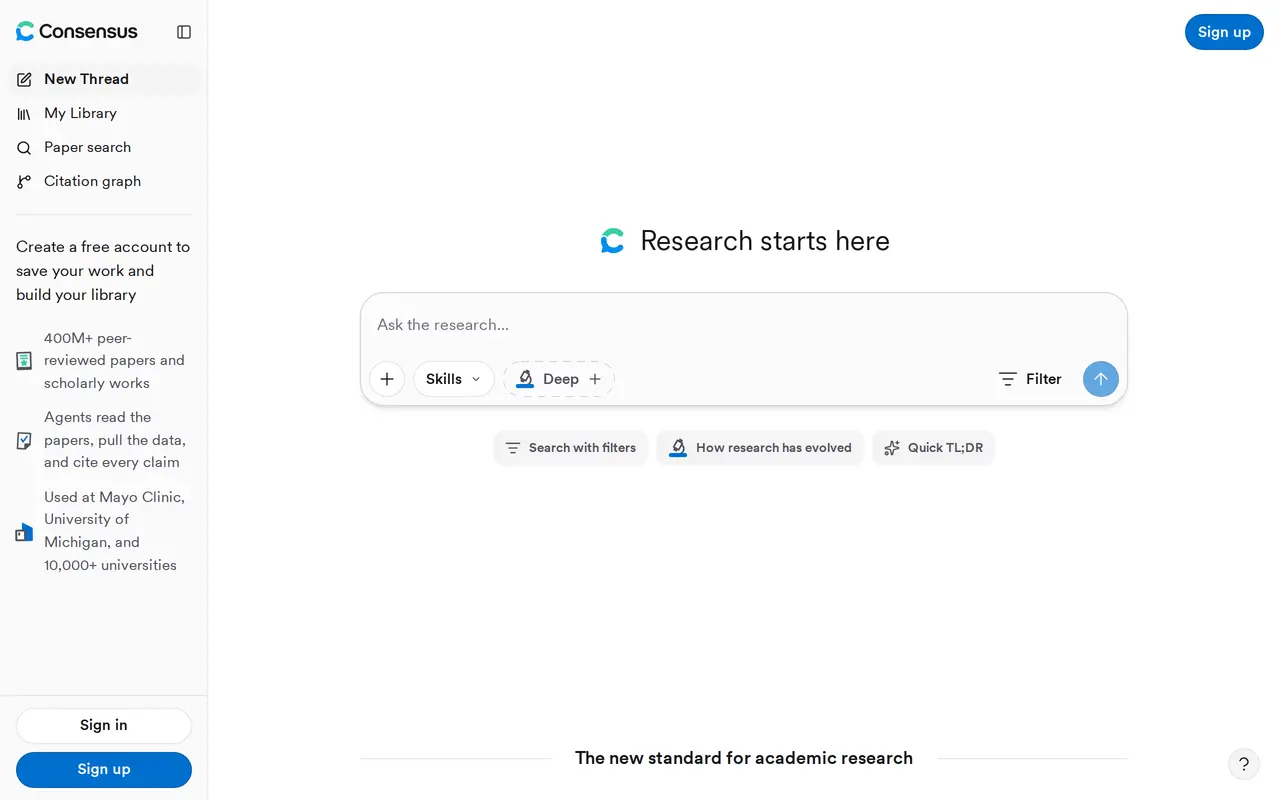
Consensus is an AI academic search engine for finding and analyzing peer-reviewed literature. It helps researchers, students, and clinicians explore questions, compare evidence, and build literature reviews. Answers include citations, so users can follow claims back to the underlying research. Its search collection includes licensed full-text content from academic publishers.
Users can ask research questions in natural language and specify requirements such as publication dates, study populations, sample sizes, and study designs. Deep Search develops a broader search strategy by expanding key terms, examining conflicting arguments, and exploring connections through the citation graph. For clear yes-or-no questions, the Consensus Meter provides a visual summary of how the evidence agrees or disagrees.
A dedicated Medical mode narrows searches to clinical guidelines and articles from selected medical journals. Users can also search individual papers and create a free account to save work and build a research library. Consensus serves individual researchers as well as universities and organizations.
What can Consensus do?
Cited research answers
Search scholarly literature and get AI-generated analysis with citations linking claims to research papers.
Deep Search
Expand search terms, examine conflicting arguments, and explore citation connections for literature reviews.
Natural-language filters
Specify dates, populations, sample sizes, and study designs in your question to filter research results.
Consensus Meter
See a visual summary of whether research agrees or disagrees with a clear yes-or-no question.
Medical mode
Focus searches on about 50,000 clinical guidelines and 8 million articles from 1,000 medical journals.
Research library
Create a free account to save your work and build a library of research.
Who is Consensus for?
- Researchers
- Find relevant studies, investigate competing explanations, and develop literature reviews.
- Students and faculty
- Search academic evidence and organize research for coursework and scholarly projects.
- Clinicians
- Explore medical questions using clinical guidelines and research from selected medical journals.
Frequently asked questions
Can I save research in Consensus?
Yes. A free account lets you save your work and build a research library.
Does Consensus cite its answers?
Yes. Its research agents read papers, extract data, and provide citations for claims.
Can I restrict searches to particular types of studies?
Yes. You can specify criteria such as timeframes, populations, study designs, and sample sizes directly in your prompt.
Is Consensus available through universities?
Yes. More than 170 university libraries partner with Consensus to provide access for students and faculty.
Consensus alternatives
Compare alternatives- 1
 ElicitSearch scientific literature, extract evidence, and generate cited research reports.
- 2
 SciteSearch scholarly literature and get AI answers backed by citations.
- 3
 You.comAPIs for live web search, cited research, and AI model inference.
- 4
 NoteGPTAn AI agent for research, summaries, documents, slides, and multimedia creation.
- 5
 ResearchRabbitDiscover related academic papers and map their connections for literature reviews.
More AI Research Tools
See more
Gemini Notebook
AI Research Tools
Research your sources and turn them into summaries, study aids, audio, and slides.

Artificial Analysis
AI Developer Tools
Compare AI models and API providers using benchmarks for capability, speed, and cost.
Scholarcy
AI Summarizers
Summarize academic papers into interactive flashcards and organize your research.

Kimi
AI Assistants
An AI assistant for coding, research, 3D creation, and agent-based tasks.

Use AI
AI Chatbots
Chat with multiple AI models, research the web, and create content in one workspace.

Aside
AI Agents
An AI browser that carries out tasks across websites and signed-in accounts.